
There’s a claim about Africa and critical minerals that gets made badly in both directions.
The overstated version says Africa holds the keys to the energy transition. The understated version says the continent is a marginal producer outside a few commodities. The truth, as always, is in between.
First, a definition.
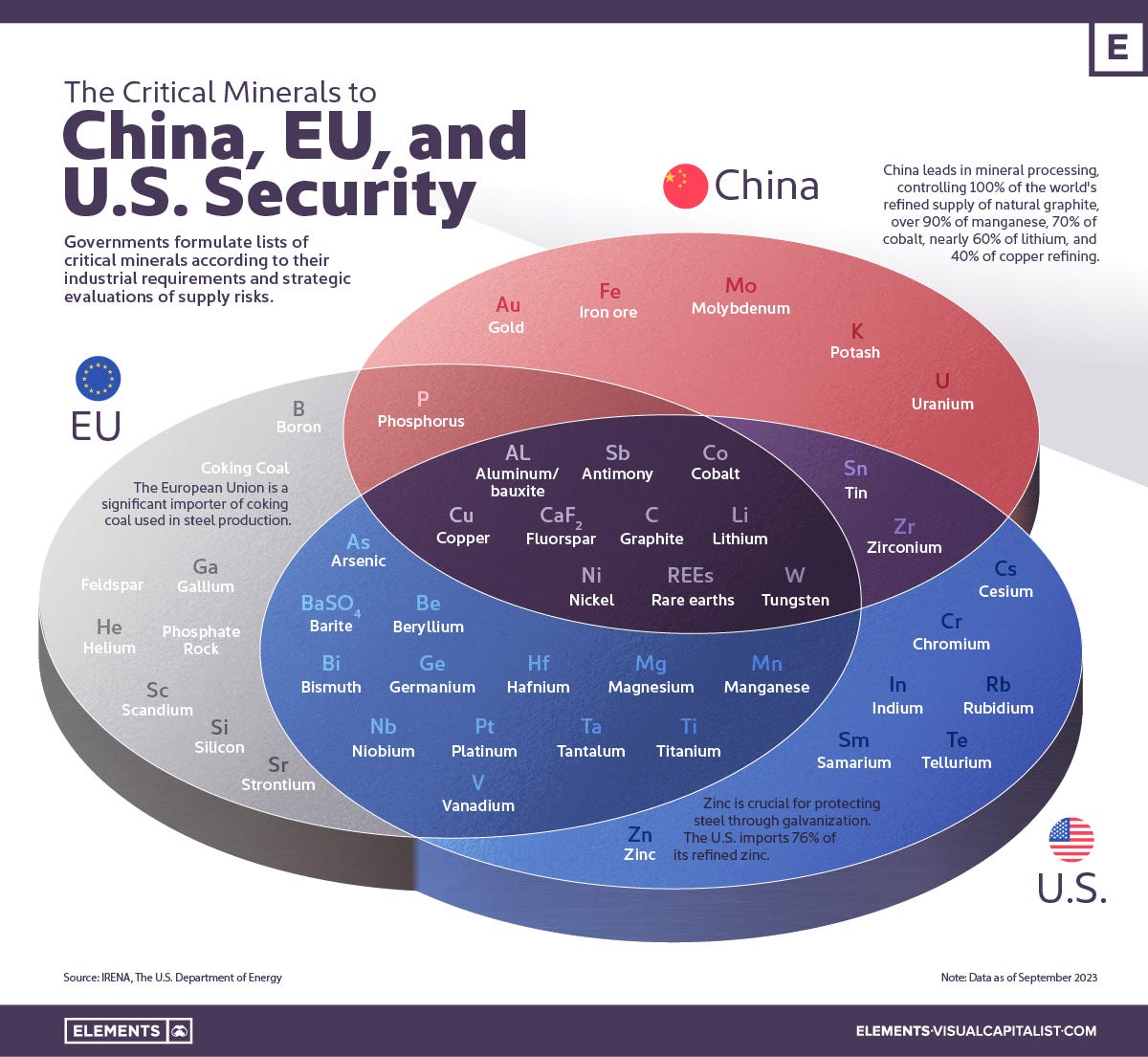
Critical minerals are the materials a government has decided its economy and military cannot run without and cannot reliably get hold of. Every large economy keeps one.
The lists overlap heavily: lithium, cobalt, graphite, rare earths, tantalum, tin, manganese, platinum group metals. Concentration in the supply chain, more than scarcity in the ground, is what puts a mineral on the list. For example, cobalt isn’t rare. It’s just that three-quarters of it comes out of one country and is almost entirely processed in another.
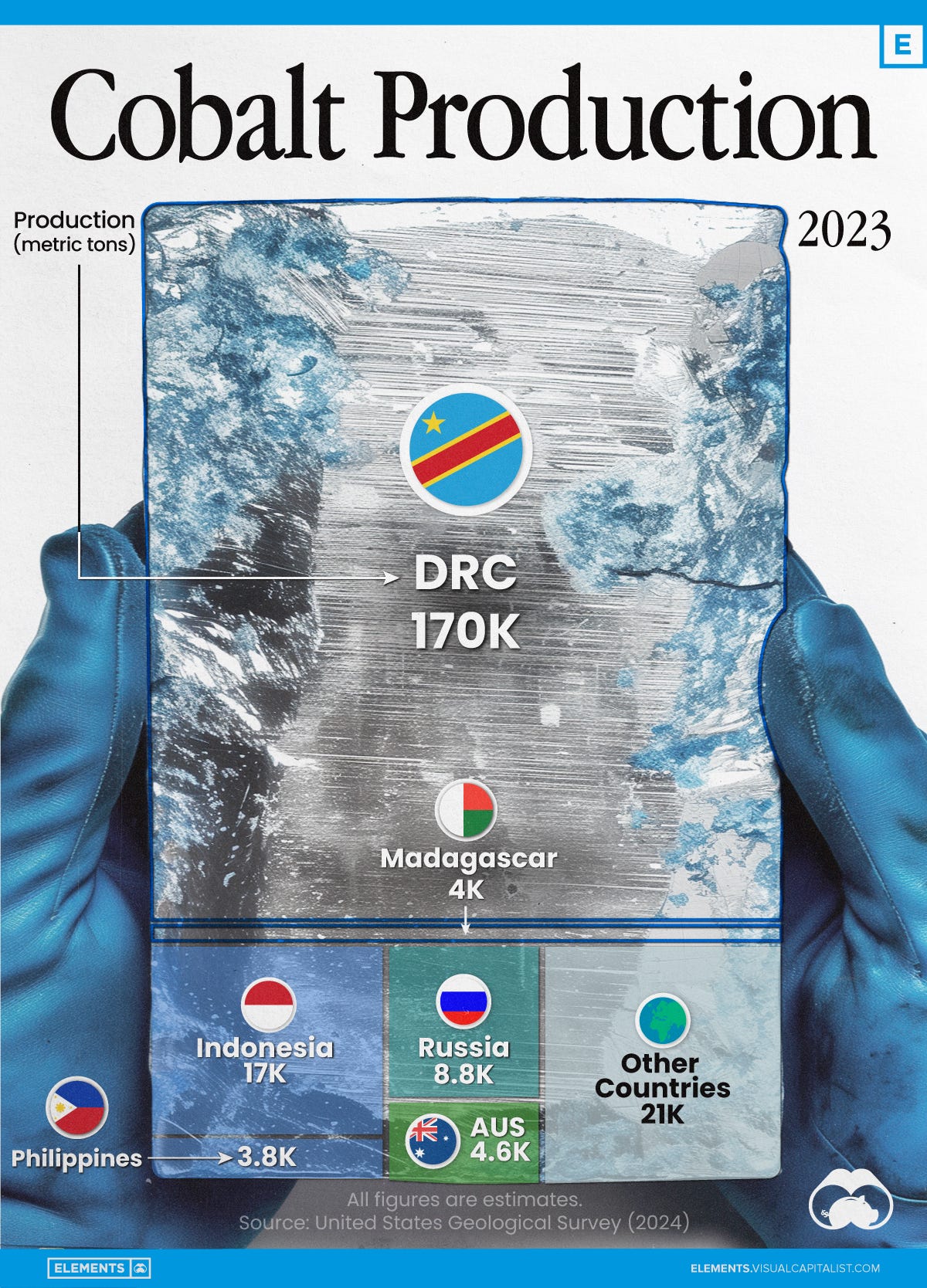
Which brings us to the leverage Africa has. The DRC produces somewhere between two-thirds and three-quarters of the world’s mined cobalt, depending on whose year you take. South Africa is the platinum group metals story (80%) and a large part of manganese. Zambia and the DRC together are the biggest single contributors to closing the world’s copper gap. Guinea is bauxite. That’s most of the verifiable truth. Clear world leaders in some important minerals, but my no means a monopoly on the whole.
But mining and processing are two different businesses, and Africa is only in one of them. The lesser-paying one.
Effectively, all of Zimbabwe’s lithium and nearly all of the DRC’s cobalt go to China. China holds 70 per cent of global cobalt refining and around 90 per cent of rare earth refining.
To put it crudely, Africa digs, and someone else adds (/takes) the value. (To be fair, this is true for non-African producers as well. Most of Australia’s lithium and Chile’s copper is processed in China.)
The continent’s beneficiation policies aim to correct this. Zimbabwe’s concentrate export ban, the DRC’s quota system, Nigeria’s rule that you don’t get a licence unless you process locally.
Speaking of which, Nigeria isn’t on most people’s list at all re critical minerals. It should be.
USGS figures say Nigeria produced around 13,000 tonnes of rare earth oxides in 2024, up about 80 per cent year on year, which put it inside the global top five. In June, Nigeria’s Ministry of Solid Minerals announced a polymetallic province in Kaduna covering PGMs, gold, nickel, copper, lithium and rare earths.
Nigeria is a good explanation for why this publication, African Commodities, exists.
The aforementioned 13,000 tonnes USGS quoted for Nigeria’s rare earth production in 2024 has since been updated in subsequent reports. The new number for that year is 1,500 tonnes. That is a sizeable difference. What happened? The former relied on estimated port data from China, i.e., what China received from Nigeria, and the latter came from government-reported data, i.e., what Nigerian officials say left Nigeria. So what is the truth?
Informational gaps like this are what this publication seeks to close.
African Commodities covers the critical minerals feeding the technology supply chain, at the operational level. Who really holds which licence, what actually moves through which port, where processing capacity is, as opposed to where it’s been announced. It runs in both directions, from the data centre or factory back to the pit and from the pit forward to the data centre, because the folks who understand one end rarely understand the other.
I spent years as a journalist, some of them freelancing at the BBC, so I verify rather than just aggregate. I have an MSc in AI and have worked in the field, so I’m not guessing about the demand side. I’m Nigerian, and I move between Lagos and London, so I can go and look, and I can tell when the two cities are describing the same asset differently. I’m not a geologist or a mining engineer, and where I’m leaning on people who are, I’ll say so.
This September I’ll give a continental view of what sits where and belongs to whom. Through October and November I’m mapping Nigeria. The licensing architecture, states building commercial positions, the all too important artisanal layer, and the businesses springing up to support them. From December, I’ll pick one commodity to focus exclusively on for 2027. I’m leaning towards copper.
If you hold a licence, work a site, sit in a ministry, or move material, tell me where the official data is wrong. That’s the most useful thing you can send me. Subscribe and share. Speak soon.